

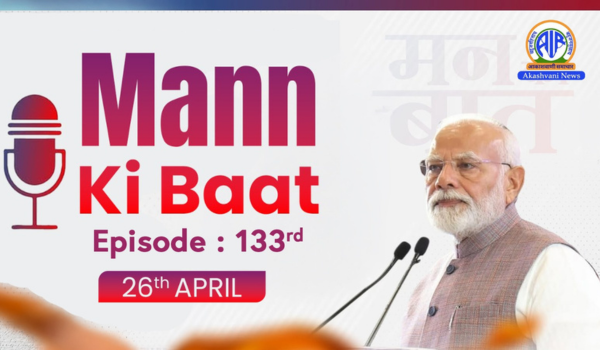
Prime Minister Narendra Modi today lauded the country’s nuclear scientists for enhancing India’s pride with the Fast Breeder Reactor in Kalpakkam, Tamil Nadu, achieving Criticality. Addressing the nation in his Mann Ki Baat programme on Akashvani, Mr Modi said Criticality is the stage during which a reactor successfully attains a self-sustaining nuclear chain reaction for the first time. This stage signifies the reactor entering the operational phase.
Prime Minister Modi termed this a historic milestone in India’s nuclear energy journey. He highlighted that the nuclear reactor is built entirely using indigenous technology. He elaborated that in addition to generating energy, the Breeder Reactor also produces new fuel for the future. He recalled witnessing the core loading of the reactor in Kalpakkam in March 2024. He congratulated everyone who had made invaluable contributions to India’s nuclear programme. The Prime Minister said the nation’s scientists are advancing the Civil Nuclear Programme and making a significant contribution to nation-building. He said this has benefited industrial growth, the energy sector, and the healthcare sector. He added that India’s Civil Nuclear Programme has helped everyone from agriculture to modern innovators.
Prime Minister Modi also spoke about the power of wind energy, saying that this power is propelling India forward. He was pleased to note that India has recently achieved a major milestone in wind energy. India’s wind energy generation capacity has now exceeded 56 gigawatts. Mr. Modi underlined that in the last year alone, nearly 6 gigawatts of new capacity have been added. He said India is progressing rapidly in wind energy, ranking fourth in the world in wind energy capacity. Mr Modi highlighted that many States in the country, including Gujarat, Tamil Nadu, Maharashtra, and Rajasthan, are blazing a trail in this sector. Large renewable energy parks are coming up in areas such as Kutch, Patan, and Banaskantha in Gujarat. The Prime Minister expressed satisfaction that the youth are benefiting from new opportunities and avenues for employment. He stated that solar and wind energy are essential for India’s development. He stressed the need to conserve electricity and embrace clean energy. He further stated that such efforts are essential at every level in the country, because they are the very ones which bring about profound change.
In today’s episode of Mann Ki Baat, Prime Minister Modi highlighted the ongoing Census campaign. He said every Indian must be aware of the Census campaign, which is the world’s largest census. Mr Modi elaborated that the Census 2027 has been made digital and all information is being recorded directly in digital form. The enumerators going door-to-door have a mobile app to enter all the information. The Prime Minister noted that the Census has been made easier this time, wherein people can enter their information themselves. This facility will open for people 15 days before the enumerator’s arrival. People can enter the information as per their convenience. After completing the process, they will receive a special ID on their mobile or email. Later, when the enumerator visits their home, people can verify the information by showing this ID. Mr Modi said this will save time and simplify the process. He shared that in States where self-enumeration has been completed, Census staff have also begun enumerating households. House listings for approximately one crore, twenty lakh families have been completed so far. He said the national census is not just a government task, but the responsibility of everybody. He said people’s participation is crucial and assured that the information provided is completely secure, confidential, and protected with digital security. He urged everyone to participate in this process and make Census 2027 a success.
Mr Modi said the month of May is beginning on a pious note with Buddha Purnima being celebrated on the first of May. He extended his best wishes to all, saying that the message of Lord Buddha remains as relevant today. He said Buddha’s teachings have become even more important amid the tensions and conflicts the world is going through today. The Prime Minister spoke about an organisation in Chile, South America, which is promoting the teachings of Lord Buddha. He highlighted that this endeavour is being conducted under the counsel of Ladakh-born Drubpon Otzer Rinpoche. This organisation is connecting meditation and compassion to people’s lives. Mr Modi said the stupa in the Cochiguaz Valley gives people a sense of peace. He highlighted that the Buddhist tradition also teaches everyone to connect with nature. The Prime Minister gave the example of Karma Monastery in Karnataka, which is a vibrant forest area spread over 100 acres. More than 700 native trees have been preserved in this forest. Mr Modi noted that during the last few years, inspiring stories of nature conservation have emerged from different parts of the country. He shared some examples with the listeners of ‘Mann Ki Baat’ today. He spoke about the Rann of Kutch, where lakhs of flamingos arrive every year as soon as the monsoons end. He said the entire area turns pink, and, therefore, the name ‘Flamingo City’ has been given. He added that the people of Kutch call them ‘Lakhha Ji Ke Baaraati’. He expressed happiness that now, Lakha ji Ke Baaraati have become a beautiful symbol of environmental conservation in Kutch. Mr Modi also mentioned the Terai region of Uttar Pradesh, where herds of elephants approach villages during the harvest season. He said this increases the risk of conflict, but efforts like “Gaj Mitra” have now begun in Uttar Pradesh. Villagers themselves form teams to monitor elephants and alert people in time. This is reducing conflict and increasing public trust. The Prime Minister shared a piece of good news from Central India, highlighting the reappearance of blackbucks in Chhattisgarh. He said ‘their numbers had dwindled significantly, but continued efforts have led to increased conservation. Today, they are once again seen roaming the open fields.’ Mr Modi said similar hope is visible in the conservation of the Great Indian Bustard, the Godavan. This bird used to be a hallmark of the nation’s desert regions, but its numbers had dwindled. Prime Minister Modi said that this bird was on the verge of extinction, but a major campaign is ongoing for its conservation. Scientific methods are being adopted, and breeding centres have been established.
The Prime Minister also spoke about the success of the Northeast in the Bamboo sector. He elaborated that what was once viewed as a burden is now giving new impetus to employment, business, and innovation. According to British law, Bamboo was defined as a tree, and the rules associated with it were very strict. Mr Modi said that it was very difficult to transport Bamboo anywhere, and people started moving away from Bamboo-related businesses as a result. He stated that his Government changed the law in 2017 and removed Bamboo from the tree category. Prime Minister Modi noted with satisfaction that, today, the Bamboo sector is flourishing throughout the Northeast. Mr Modi mentioned Bijoy Sutradhar of Gomati district of Tripura and Pradeep Chakraborty of South Tripura. He said that ‘they saw the new laws as a huge opportunity for themselves and integrated their work with technology. Today, they are producing better and more bamboo products than ever before.’ Mr Modi highlighted that there are several Self-Help Groups that have lent value addition to bamboo-based food products in Dimapur and the surrounding areas of Nagaland. He said there are also teams like Khorolo Creative Crafts, which are working on Bamboo furniture and handicrafts. He further stated that teams are working on bamboo tissue culture and poly-house management in the Mamit district of Mizoram. He also spoke about the Lagastal Bamboo Enterprise Team near Gangtok in Sikkim, which makes handicrafts, incense sticks, furniture, and interior decor items from bamboo. Mr Modi urged people to purchase one bamboo product from the Northeast, saying their efforts will encourage those who toil hard to make Bamboo products.
Prime Minister Modi emphasised that Beating Retreat is an important part of the festivities of the Republic Day. He said this ceremony showcases the diverse musical traditions of different bands. Mr Modi noted that over the past few years, the inclusion of Indian music has increased, which is being liked by people across the country. This year’s Beating Retreat ceremony was also memorable, with the Air Force, Army, Navy, and CAPF bands giving excellent performances. The Prime Minister further stated that the splendid formations of Beating Retreat draw everyone’s attention. He said the Air Force band showed the Sindoor formation, and the Naval Band displayed the Matsya Yantra formation. The Army Band’s performance also showcased 150 years of Vande Mataram and India’s success in cricket. The Prime Minister announced that a highly commendable initiative has been undertaken, and the music of Beating Retreat is available on WAVES OTT. He said this will be available on other platforms as well in future. He urged people to listen to the performance and feel proud of the Armed Forces and their traditions.
The Prime Minister also shared that the National Archives of India has digitised and made public over 20 crore invaluable documents. He highlighted that these documents include 7th-century Gilgit manuscripts written on Bhoj Patra, and an interesting 8th-century text, Siribhoovalay. The documents also include some significant letters related to Rani Lakshmibai, revealing some decisions she made in 1857. There are many documents related to Netaji’s life, the Azad Hind Fauj, and his speeches. Many documents are related to Pandit Madan Mohan Malaviya, including important information related to the establishment of BHU and the Hindi Sahitya Sammelan. Many unique documents related to the Constituent Assembly are also available. Mr Modi urged listeners to visit www.abhilekh-patal.in for a wonderful experience of India’s history. The Prime Minister also lauded the team which participated in the European Girls Mathematical Olympiad held in Bordeaux, France, earlier this month, and ranked sixth. He said it is one of the most prestigious competitions in the world, and the nation’s daughters performed their best in this Olympiad. The talented team included Shreya Mundhra from Mumbai, Sanjana Chacko from Thiruvananthapuram, Shivani Bharat Kumar from Chennai and Shrimoyee Bera from Kolkata. Shreya created history by winning the Gold Medal. Sanjana secured for herself the Silver Medal, and Shivani, the Bronze Medal. The Prime Minister elaborated that the selection process for this Olympiad in India is very tough in itself. It is a multi-stage selection process, where tough challenges have to be overcome at the regional, State, and national levels. The best performing students participate in a one-month Mathematics Training Camp, which is organised at the Homi Bhabha Centre for Science Education of the Tata Institute of Fundamental Research. At the end of this camp, a team selection test is conducted. The Indian team is selected based on the performance in this test. Every year, around 6 lakh students from across the country participate in this Mathematical Olympiad Programme. Mr Modi appreciated the parents as well for supporting these gifted girls.
Prime Minister Modi exuded pride that two Indian cheese brands have received prestigious awards at an international cheese competition held in Brazil. He noted that a major change is taking place in India’s dairy sector and Indian cheese is making its mark globally. He cited the example of Jammu and Kashmir’s Kalari cheese, which is known as the “Mozzarella of Kashmir.” The Gujjar-Bakarwal community has been making and eating it for generations. Mr Modi mentioned “Chhurpi”, which is popular in Sikkim, Arunachal Pradesh, and Ladakh. He also spoke about “Topli Nu Paneer,” also known as “Surti Cheese” in Maharashtra and Gujarat. He stressed that modern technology is emerging, packaging is improving, and Indian products are meeting world standards. As a result, Indian cheese is now transcending the country’s borders and reaching global markets and restaurants. He expressed confidence that India’s taste, tradition, and quality will provide a new experience to people across the world.
The nation will celebrate Gurudev Rabindranath Tagore’s birth anniversary on the 9th of May on the occasion of ‘Pochishe Boishakh’. Mr Modi paid tributes to Gurudev Tagore, saying he was a multifaceted personality who shaped many renowned institutions. He said Gurudev Tagore advocated for industries that provided sustainable employment and benefited villages. He added that the influence of Rabindra Sangeet continues worldwide even today. The Prime Minister said that the month of May also reminds everyone of the First War of Independence of 1857. He saluted all the brave freedom fighters who awakened the spirit of patriotism among the people. Concluding his address, Mr Modi urged children to enjoy their summer vacation to the fullest and try to learn something new. He asked everyone to take care of their health during the summer season.