




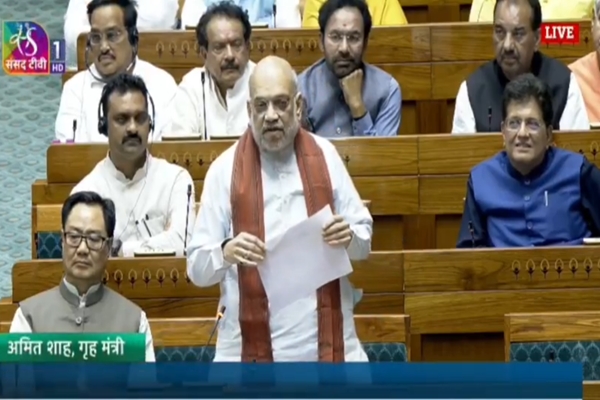
In a brief intervention during the discussion on the Constitution (One Hundred and Thirty-First Amendment) Bill, 2026, and the Delimitation Bill, 2026, and the Union Territories Laws (Amendment) Bill, 2026 in Lok Sabha, Union Home Minister Amit Shah rejected the apprehensions of the opposition regarding reduction in number of Lok Sabha seats in southern states after delimitation exercise. Mr Shah clarified that the proposed framework ensures that no region will lose seats in absolute terms, and that southern states will see a rise in representation. Mr Shah said, at present out of the 543 seats, the strength of Southern States in the House is 129, which is approximately 23.76 percent and as per the new strength of the Lok Sabha, the number of seats will go up to 195. He added that the exercise is designed to maintain balance and fairness while accommodating changes in population.
Earlier, Union Law Minister Arjun Meghwal introduced the Constitution (One Hundred and Thirty-First Amendment) Bill, 2026, and the Delimitation Bill, 2026 in the Lok Sabha today. Home Minister Amit Shah introduced the Union Territories Laws (Amendment) Bill, 2026 in the House.
Introducing the Bills, Law Minister Arjun Ram Meghwal termed the day as historic saying the government is working to give political justice to women. He said the Constitution (One Hundred and Thirty-First Amendment) Bill, 2026, will ensure equality for women. Quoting Dr BR Ambedkar, Mr Meghwal stressed that the progress of a community is measured by the degree of progress which women have achieved. The Law Minister said that to implement a uniform and legally consistent distribution of reserved seats for women across the country, it would be necessary to increase the total number of seats in the Lok Sabha by 50 per cent over the current strength. He added that with such an increase, the new strength of the Lok Sabha would be 815 members. He said that out of these, 272 seats would be reserved for women, which comes in addition to the existing allocation.
The Law Minister said that the results of Census 2027 are not expected to be available before the end of 2027 or the beginning of 2028. He informed that, therefore, the 2011 Census will be used for the readjustment or division of territorial constituencies and for the allocation of seats for Scheduled Castes and Scheduled Tribes. Mr Meghwal said the Narendra Modi government has brought a number of schemes for the economic and social upliftment of women. He cited MUDRA Yojana, Lakhpati Didis and Sukanya Samridhhi Yojana as among the schemes brought by the government.
Initiating the discussion, Congress MP Gaurav Gogoi said his party is in favour of women’s reservation, but it should be simplified and not linked with delimitation. He said the reservation should be based on the existing 543 seats in the Lok Sabha. He alleged that the government is creating unnecessary delays in implementing the women’s reservation and urged the government to bring it into force immediately. Mr Gogoi reiterated that Congress has consistently supported women’s reservation. He highlighted that senior Congress leader Sonia Gandhi had earlier made a similar demand in Parliament, emphasizing reservation for women.
Participating in the debate, Congress MP Priyanka Gandhi Vadra said that the provision of women reservation in Panchayats and Municipalities was first introduced by the Congress government under the leadership of former Prime Minister Rajiv Gandhi. She said the move marked a significant step in advancing women’s political participation at the grassroots level. Congress leader Priyanka Gandhi also questioned the Centre’s decision to link the implementation of the women’s reservation law to a future delimitation exercise. She questioned why the government cannot roll out the reservation for women immediately with the current Lok Sabha strength of 543 without increasing the number of seats. She alleged that the government wants to take away the rights of OBCs by not conducting the caste census and sticking to 2011 census figures.
Tejasvi Surya of BJP said that today is a historic day as the women of the country, who have been waiting for nearly four decades, are now set to receive their due share. He said, by introducing three new bills, the Narendra Modi government is fast-tracking the Women’s Reservation bills. Mr Surya said, the move is being seen as a significant step towards opening a new chapter in India’s development journey. He emphasised that, for the first time, the Nari Shakti of the country will receive vocal, visible, credible, and tangible representation in the nation-building process.
Participating in the discussion, Samajwadi Party MP Akhilesh Yadav said that his party supports women’s reservation. However, he questioned the government to bring such important legislation in a hasty manner. He said that the Women’s Reservation Bill should be introduced only after the completion of the latest census drive.
Telugu Desam Party leader Dr Byreddy Shabari has said that women today are ready to lead the nation from the grassroots to the national level. She thanked Prime Minister Narendra Modi for bringing this important legislation, which is aimed at enhancing women’s participation in governance.
Arvind Sawant of Shiv Sena (UBT) said that his party is opposing the Delimitation legislation as it is against the Constitution and also hurts the federal structure.
BJP MP Bansuri Swaraj supported the legislations saying the Delimitation Bill saying that the delimitation exercise is a constitutional mechanism and not a BJP agenda. He said, the intention of the government is to implement the Nari Shakti Vandan Adhiniyam.
Pratima Mandal of AITC demanded the increasing the reservation for women from the proposed 33 percent of 50 percent.
Besides, Dr D Purandeswari of BJP, Abhay Kumar Sinha of RJD, E T Mohammed Basheer of IUML, K Subbarayan of CPI, Malvinder Singh Kang of AAP , Tangella Uday Srinivas of Janasena Party , Manish Tewari of Congress and Joba Majhi of JMM also participated in the discussion.
