


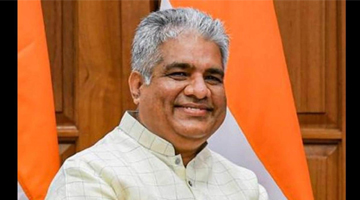
Minister of Environment, Forest and Climate Change Bhupender Yadav today said that India is advancing systemic reforms across four strategic pillars, which are energy transformation, sustainable economic transition, nature-based solutions and digital environmental governance.
Speaking at the inaugural session of The Energy and Resources Institute-TERI’s World Sustainable Development Summit (WSDS) in New Delhi, Mr Yadav said that transformation does not mean abandoning development but redefining it within ecological limits, with social justice and intergenerational equity. He also mentioned that India aims to achieve 500 gigawatts of non-fossil fuel energy capacity by 2030, reduce greenhouse gas emission intensity of its GDP by 45 per cent from 2005 levels and advance the National Green Hydrogen Mission and build climate-resilient industries. Mr Yadav said India has consistently upheld the principles of common but differentiated responsibility, climate justice, equitable carbon space and inclusive carbon markets.
The Minister also congratulated TERI for launching the Himalayan Coalition, which reinforces the importance of community-centred and inclusive approaches to sustainable development. He made a special mention of Him-CONNECT, a structured platform to translate research supported under the National Mission of Himalayan Studies into scalable solutions. Mr Yadav said Him-CONNECT aligns with India’s broader sustainability approach, which places communities at the centre of environmental action. The three-day summit marks the 25th edition of WSDS. This year, the theme of the summit is “Transformations: Vision, Voices, and Values for Sustainable Development.