




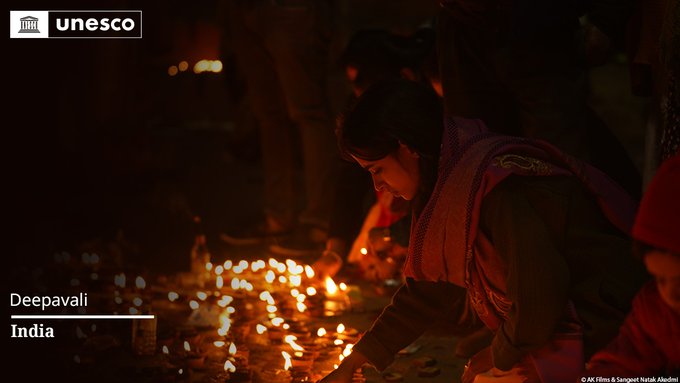
Deepavali, the festival of lights, has been inscribed on UNESCO’s List of the Intangible Cultural Heritage of Humanity, announced at the 20th UNESCO Intergovernmental Committee session at New Delhi’s Red Fort from December 8-13, 2025.
It is the 16th Indian element on this list. In Nepal, a Musical Bhajan evening with the lighting of lamps in the Pashupati temple premises was organised in celebration of the inscription of Deepavali in UNESCO’s List of the Intangible Cultural Heritage of Humanity. Residents of Nepal welcomed the move.
Indian Citizen Association of Nepal, ICAN President Manoj Kandoi shared his view that global awareness about Diwali will reinforce efforts to safeguard community-based traditions for future generations.
Kamal Khandelwal, a resident of Nepal, congratulated the community observing Deepavali every year, as they celebrated Diwali as part of their custom, from the Recognition of Diwali as UNESCO Cultural Heritage gives him pride.
Other UNESCO Intangible Cultural Heritage from India are Garba of Gujarat (2023), Durga Puja in Kolkata (2021), Kumbh Mela (2017), Yoga (2016), Traditional brass and copper craft of utensil making (Thatheras of Punjab) (2014), Sankirtana (Manipur) (2013), Buddhist chanting of Ladakh (2012), Chhau dance (2010), Kalbelia folk songs and dances (Rajasthan) (2010), Mudiyettu (Kerala) (2010), Ramman (Garhwal Himalayas) (2009), Kuttiyattam (Sanskrit theatre) (2008), Tradition of Vedic chanting (2008), Ramlila (Traditional performance of the Ramayana) (2008).
The inscription was adopted in the presence of delegates from 194 Member States, international experts, and representatives of UNESCO’s global network. The Festival of Lights is an annual living tradition celebrated in India. PM Narendra Modi welcomed UNESCO’s recognition of Diwali, stating that Deepavali is deeply linked to India’s culture and ethos, and represents the very soul of our civilisation.
On the New Moon night of Diwali, residences, thoroughfares, and temples are illuminated with numerous oil lamps, emanating a warm golden glow that represents light overcoming darkness and righteousness triumphing over evil. In the evening, the sky is illuminated by a spectacular display of fireworks.
Rituals associated with cleaning homes, markets and public spaces promote hygiene and a healthy lifestyle, while the coming together of families and friends enhances social and emotional well-being.
The inscription of Deepavali on the UNESCO Intangible Cultural Heritage List is a tribute to the millions who celebrate it with devotion, to the artisans who keep its traditions alive, and to the timeless principles it represents. It tells the world that India’s cultural heritage is not merely remembered, it is lived, loved, and passed forward.
