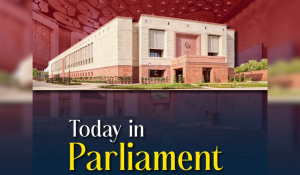


The Rajya Sabha today took up Private Members’ Legislative Business, in which several Members moved different bills. SS(UBT) MP moved the Airline Passengers’ Rights Bill, while A A Rahim of CPI (M) moved the Educational Consultancies Regulation Bill. Sanjay Seth of the BJP moved the Small Claims Court Bill.
Independent MP Kartikeya Sharma today introduced a Bill named the Critical Infrastructure (Resilience, Protection and Accountability) Bill, 2026. It aims to provide for the identification, designation, and protection of critical infrastructure of strategic importance, to establish a framework for its resilience through technological integration and to impose strict liability and accountability on parties responsible for failure of or loss of lives due to defects in the critical infrastructure. The proposed legislation has been brought in the backdrop of repeated incidents involving the collapse or failure of bridges, roads, buildings and other public structures, where cases often end without accountability due to procedural and contractual complexities. The Bill seeks to ensure that loss of life caused by negligence in infrastructure projects is treated not as a technical lapse, but as a serious criminal offence. He said that infrastructure is not merely about concrete and steel but is directly linked to the daily safety of millions of citizens, and that accountability must be fixed when lives are lost due to negligence.
Mr Sharma today also introduced the Shakti Samman (Pay Equity for Women) Bill, 2026, in the Upper House. The Bill proposes an AI-based portal and a work of equal value standard to bridge the gender pay gap and ensure genuine economic justice for Indian women. It aims to enforce the fundamental right of women to equal pay for work of equal value, to prescribe objective standards for job evaluation to eliminate gender bias in remuneration, to establish the National Authority for Pay Parity of Women with distinct investigative and adjudicatory powers and to prohibit systemic wage discrimination and non-transparent pay practices. Mr Sharma said that true empowerment is possible only when women’s contributions are valued with the same dignity and economic worth as men’s. He added that the Shakti Samman Bill is not a critique of the past but a blueprint for a fairer future, using AI and transparent audits to make pay equity a real right for every working woman.