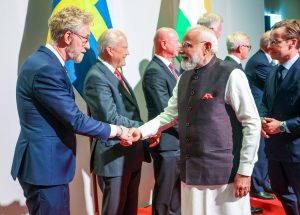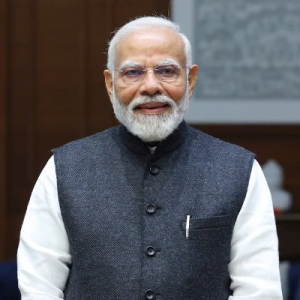


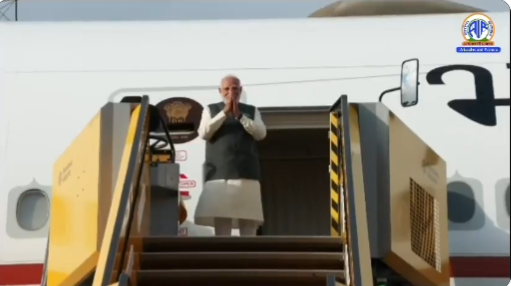
Prime Minister Narendra Modi has left for Norway after concluding his two-day visit to Sweden today. Mr Modi, in a social media post, said his visit to Sweden was marked by several important outcomes that will add new momentum to bilateral relations.
He said that, from elevating their bilateral ties to a Strategic Partnership, launching the Joint Innovation Partnership 2.0 and the India-Sweden Technology and Artificial Intelligence Corridor, to setting an ambitious goal of doubling bilateral trade in the next five years, the discussions were highly productive. He thanked the people of Sweden, the Government of Sweden and Prime Minister Ulf Kristersson for the warmth and friendship.
An Akashvani correspondent covering the Prime Minister’s visit to Sweden reports that the elevation of bilateral ties to the level of a Strategic Partnership is guided by the India-Sweden Joint Action Plan (2026-2030). The comprehensive roadmap aims to double bilateral economic exchange within the next five years and deepen cooperation under the “Make in India” and “Made with Sweden” initiatives, particularly in areas such as green hydrogen, semiconductors, and advanced manufacturing.
A defining moment of the visit was the conferment of the ‘Royal Order of the Polar Star’ upon the Prime Minister – Sweden’s highest honour for foreign heads of government – symbolising the deepening civilisational and democratic bonds between the two nations.
The visit witnessed six major achievements. The first was the adoption of the Joint Action Plan (2026-2030), which lays out an ambitious roadmap for cooperation across trade, innovation, climate action, defence, and emerging technologies. The second major outcome was the strengthening of technological collaboration through the launch of the Joint Innovation Partnership 2.0 and the expansion of the Sweden-India Technology and AI Corridor (SITAC), aimed at connecting the startup ecosystems of both countries.
The third achievement was the agreement to establish a virtual India-Sweden Joint Science and Technology Centre (ISJSTC), which will focus on frontier technologies such as Artificial Intelligence, 6G, quantum computing, and life sciences. The fourth major development was the commitment to double bilateral trade between the two nations within the next five years. Notably, Swedish Prime Minister Ulf Kristersson expressed confidence that the target could be achieved even earlier, reflecting the rapidly growing economic engagement between India and Sweden.
The fifth achievement was the development of the India-Sweden SME and Startup Platform, which is expected to enhance innovation-driven cooperation and create new opportunities for entrepreneurs and small businesses in both countries. The sixth significant aspect of the visit was the celebration of shared cultural and intellectual ties through the launch of the “Tagore-Sweden Lecture Series”, commemorating the centenary of Gurudev Rabindranath Tagore’s historic 1926 visit to Sweden.
Apart from these initiatives, both countries also announced a new phase of the Leadership Group for Industry Transition (LeadIT), aimed at strengthening cooperation in green steel, industrial decarbonisation, and sustainable industrial transformation. Though brief, the Prime Minister’s visit to Sweden further cemented the growing strategic partnership and highlighted the shared vision of India and Sweden for innovation-driven, sustainable, and future-oriented cooperation.