


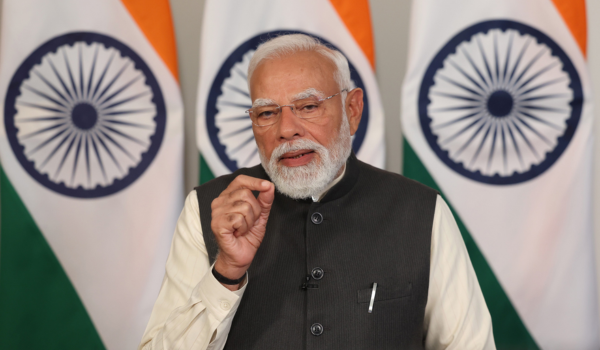
Prime Minister Narendra Modi listed three priorities for the next decade – more structural reforms, deepening innovation, and simpler governance. In an interview with a news agency, Mr Modi asserted that his government’s “Reform Express” is benefiting common citizens in a big way.
The Prime Minister said this year’s Union Budget reflects India’s yearning to become a developed nation. He added that the budget is not a ‘now or never’ moment born out of compulsion but a ‘we are ready’ moment born out of preparation and inspiration. He highlighted that the benefits of a decade of defence reforms were evident during Operation Sindoor, asserting that India has to be prepared at all times to deal with security challenges.
He stressed that India has a duty to modernise its defence sector in line with current realities as a country that is playing an increasingly important role in the world. Citing the allocation of Rs 7.85 lakh crore to the defence sector in the Union Budget 2026-27, Mr Modi said the outlay is 15 per cent higher than the previous budget. He further stated that it is also the biggest chunk given to any ministry or department.
The Prime Minister also said that women will play the most important role in creating Viksit Bharat, and initiatives taken by the government will empower them. On the trade deals being done by India, the Prime Minister remarked that political stability and political predictability have restored investor confidence in India. He added that stronger manufacturing, services, and MSMEs have enabled India to negotiate trade pacts from a position of strength.
He highlighted that India’s Free Trade Agreements are designed to expand market access for MSMEs in textile, leather, chemicals, handicrafts, gems and other sectors. Mr Modi criticised the UPA government, alleging that their economic mismanagement left India unable to negotiate from a position of confidence. He further stated that reform is the commitment of his government, and this has been demonstrated in letter and spirit.
Emphasising that the private sector is critical for the next phase of economic transformation, the Prime Minister requested a ‘decisive response’ from them. He added that the private sector must focus less on protecting margins and invest aggressively in R&D, supply chain, and quality. He said the next leap to Viksit Bharat will depend on bold investment by the private sector in innovation, long-term capacity, and global competitiveness.