

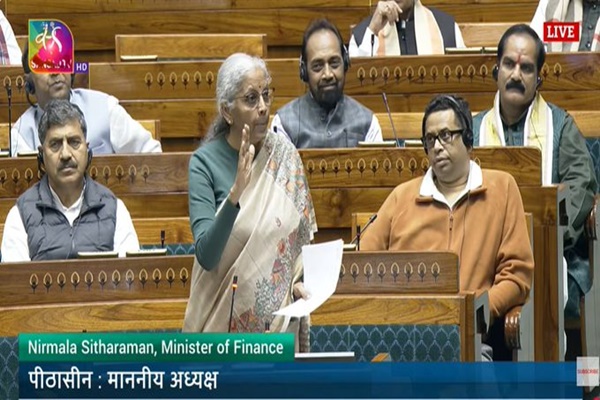
The Lok Sabha has passed the Central Excise (Amendment) Bill, 2025. The proposed law aimed to amend the Central Excise Act, 1944, specifically to raise excise duties and cess on tobacco products such as cigarettes, cigars, hookah tobacco, chewing tobacco, zarda and scented tobacco. The amendment is required to give the government the fiscal space to increase the rate of central excise duty on tobacco and tobacco products so as to protect tax incidence, after the cess ends.
Replying to a debate on the Bill, Union Finance Minister Nirmala Sitharaman said, this is not a new law and not even an additional tax. She said, it is not a cess but it is an excise duty which existed before GST. She said, even after GST came into effect, compensation cess rates remained unchanged from July 2017 to 2024. Ms Sitharaman said tobacco rates were increased annually prior to implementation of GST. She said this was primarily due to health-related concerns, as higher prices or taxes were intended to act as a deterrent so that people would not get into the habit of tobacco consumption. The Minister said, the country’s total incidence on cigarettes is 53 per cent of the retail price. She said, compensation cess is reverting back to the Centre to be collected as Excise duty, which will be redistributed to the States in the form of 41 per cent tax devolution.
Ms Sitharaman said, there have been efforts in the past and even now, to make farmers aware of the harm of growing tobacco. She said, the crop diversification programme under the Rashtriya Krishi Vikas Yojana covers 10 major tobacco growing States. The Minister said, over one lakh 12 thousand acres of land have been shifted from cultivation of tobacco to other crops between 2018 to 2021-22.
The Minister highlighted that the government health expenditure as a percentage of GDP rose from 1.13 percent to 1.84 percent between 2014-15 to 2021-22. She also said, the government health expenditure share of overall government spending also increased from 3.94 percent to 6.12 percent. She said, under the Ayushman Bharat-Pradhan Mantri Jan Arogya Yojana, financial protection is being provided to 55 crore beneficiaries. She added that since the launch of the scheme, over 9 crore hospital admissions were recorded resulting in free treatment worth over 1.3 lakh crore rupees. The Minister said, 5.46 crore children and 1.32 crore pregnant women have been vaccinated against 12 diseases under various phases of Mission Indradhanush. This targeted initiative contributed to a significant decline in the Maternal Mortality Ratio, from 130 per lakh live births to 80 between 2014 to 2020.
Earlier, initiating the discussion, Dr D Purundeswari of BJP said that Tobacco addiction is a major problem in the country as an estimated 1.35 million deaths occur annually due to cancer, heart and lungs related diseases. She said, country accounts for almost one-sixth of the world’s tobacco-related deaths. She said, the Bill is intended to maintain the price stability of tobacco products and act as a deterrent and protect the vulnerable and youth of the society by discouraging the use of tobacco. She stressed that the legislation will also not affect the States’ revenues as the share of Central tax devolution that goes to the States would stand as it is.
Karti P Chidambaram of Congress said that tobacco has a huge cost on the nation, as the economic loss, due to the use of tobacco products is nearly two lakh crore rupees annually. He also said that it is wrong to think that the increase in prices on sin products like tobacco products will help lower its consumption, because people will find other alternatives. He said, there is a need to work on a holistic plan to address the use of tobacco and to relocate people who are engaged in the tobacco sector to other sectors. Naresh Chandra Uttam Patel of Samajwadi Party demanded the government to refer the bill to the Standing Committee as the legislation will impact the tobacco growers. Supriya Sule of NCP (SCP), Sougata Roy of Trinamool Congress, Lavu Sri Krishna Devarayalu of TDP, Ravindra Waikar of Shiv Sena, Raja Ram Singh CPI(ML) and others also participated in the discussion. After the discussion, the House was adjourned for the day to meet again tomorrow.
The Bill is intended to increase central excise duty on unmanufactured tobacco, manufactured tobacco, tobacco products, and tobacco substitutes. While the Central Excise Act, 1944 levies an excise duty ranging between 200 rupees and 735 rupees per thousand cigarettes, the enhanced duty under the Bill ranges between two thousand 700 rupees and 11 thousand rupees per thousand cigarettes. The Bill also prescribes higher excise duties for manufactured tobacco products. For instance, the duty on chewing tobacco will increase from 25 percent to 100 percent. Duty on hookah will increase from 25 percent to 40 percent. For smoking mixtures for pipes and cigarettes, the duty is proposed to be increased from 60 percent to 325 percent. The purpose of the bill is to protect people from the ill effects of tobacco and to discourage them from its consumption.