


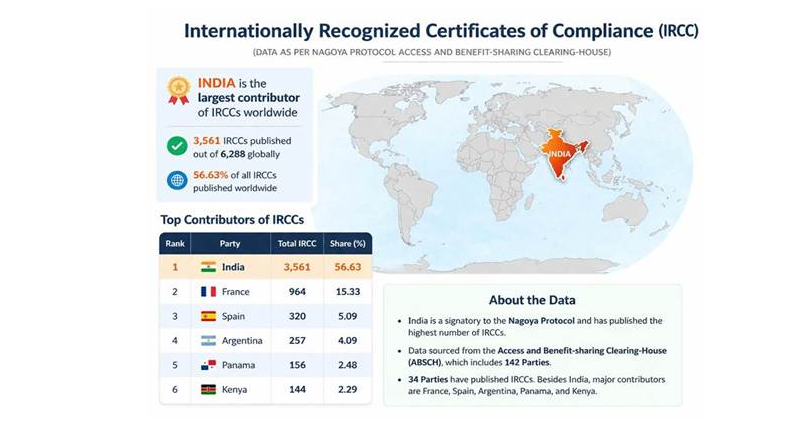
India has emerged as the global leader in issuing Internationally Recognized Certificates of Compliance, (IRCCs), under the Nagoya Protocol on Access and Benefit-sharing (ABS). The Ministry of Environment, Forest and Climate Change informed that IRCCs serve as official proof that Prior Informed Consent has been obtained and Mutually Agreed Terms have been established between users and providers of genetic resources. It added that they play a crucial role in ensuring transparency and fair sharing of benefits arising from the use of biological resources.
According to the latest data available on the ABS Clearing-House, the country has issued 3,561 IRCCs out of a total of 6,311 worldwide, accounting for over 56 percent of all certificates. Out of 142 countries registered on the platform, only 34 have issued IRCCs so far. France follows India with 964 certificates, while Spain, Argentina, Panama and Kenya trail behind.
India’s strong performance reflects the effective implementation of its Access and Benefit-sharing framework under the Biological Diversity Act, 2002. The National Biodiversity Authority, along with State Biodiversity Boards and local Biodiversity Management Committees, has streamlined procedures and strengthened compliance mechanisms.