


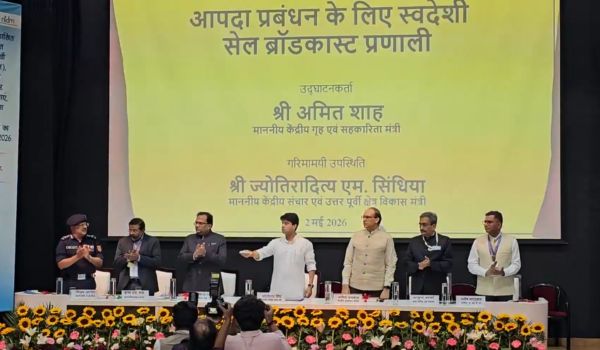
Communications Minister Jyotiraditya Scindia today launched the Cell Broadcast System (CBS) to strengthen India’s emergency communication systems and enhance public safety infrastructure. CBS is an indigenous technology developed by the Centre for Development of Telematics (C-DOT) under the Department of Telecommunications, in collaboration with the National Disaster Management Authority and the Ministry of Home Affairs.
A nationwide test of the system was successfully conducted today, during which emergency alert messages were broadcast to mobile phones across the country. As part of it, a notification with a siren alert was sent to the mobile devices of citizens around noon to test the system.
Speaking at the launch in New Delhi, the Minister called it a transformative step in India’s disaster management framework, reflecting the shift from a reactive to a proactive approach in safeguarding citizens. Mr Scindia said that by leveraging advanced telecom technologies, CBS enables near real-time, geo-targeted alerts to reach millions instantly, ensuring that no individual is left behind.
The Minister added that this indigenous, globally benchmarked solution strengthens the country’s preparedness, enhances response capabilities, and reinforces its commitment to building a safer, more resilient India. Union Home Secretary Govind Mohan and Secretary Telecom Amit Agrawal were present on the occasion.
The Cell Broadcast System (CBS) offers precise geo-targeting capabilities, enabling alerts to be disseminated at the level of individual cell towers or clusters, while also allowing scalability to cover larger geographic areas. It overcomes the limitations of traditional SMS-based systems, ensuring that critical information can be disseminated quickly and efficiently to large populations within targeted areas.
The system enables near real-time, multilingual alerts that provide critical time for protective action in disasters such as flash floods and gas leaks, reaching users within seconds without any queuing delays. By enabling direct, official communication, it strengthens disaster management, drives quick response, reduces panic, and enhances public trust and compliance. These alerts are delivered as priority notifications, appearing as pop-up messages accompanied by distinct loud tones, with message text read aloud on supported mobile handsets.