


Parliament has passed the Sustainable Harnessing and Advancement of Nuclear Energy for Transforming India Bill, 2025, with the Rajya Sabha approving it today. The Lok Sabha passed the legislation yesterday. It replaces the Atomic Energy Act, 1962 and the Civil Liability for Nuclear Damage Act, 2010. The legislation aimed at the development of nuclear energy and ionising radiation for nuclear power generation for the welfare of the countrymen. It also seeks to provide a robust regulatory framework for its safe and secure utilisation. The Bill seeks to constitute the Atomic Energy Regulatory Board and establish the Atomic Energy Redressal Advisory Council.
The Bill also provides for the liability of the Central Government in the event of a nuclear incident. The Central Government has established a Nuclear Liability Fund for the purpose of meeting its liability under the Bill. The legislation enables the Board to regulate the manufacture, use, export, import, transport, and transfer of any radioactive substances and radiation-generating equipment. It further empowers the Central Government to specify measures for the security of radioactive substances. The Bill empowers the Central Government to undertake exploration activities for the discovery of uranium or thorium.
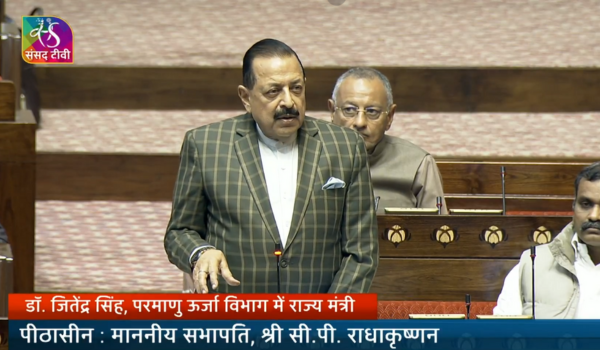
Replying to a discussion on the Bill, Minister of State for Atomic Energy Dr Jitendra Singh said, the Government in the last decade has made very big headways in the nuclear sector. He said, be it cancer treatment with nuclear medicine or food preservation or in the fields of agriculture, nuclear technology is contributing in a big way. Dr Singh said, technology has changed, and the country is now focusing on small modular reactors. He said there will now be reactors that will give power in dense areas. The Minister said the Government has set a target of achieving 100 gigawatts of nuclear energy capacity by 2047. He informed that the Bill has taken more than one year of consultations. He assured the House that there will be no compromise on the safeguard aspects.
Initiating the discussion, Jairam Ramesh of Congress, in his speech, sought to outline the development of atomic energy in India. He said development should be driven by the public sector. Mr Ramesh said that if it is taken over by the private sector, it would amount to overlooking the convictions of the scientists who spearheaded the nuclear programmes of the country.
Kiran Chaudhary of BJP said, the Bill repeals old scattered regulations and replaces them with a single, unified and modern framework covering licensing, safety approvals, liability and compensation. She said, former Prime Minister Atal Bihari Vajpayee had laid a solid foundation on nuclear energy with a clear focus on national security and public safety, and now this vision has been concretised and taken forward by Prime Minister Narendra Modi. Sagarika Ghose of TMC opposed the Bill, saying it is fundamentally dangerous.
YSRCP MP Ayodhya Rami Reddy Alla said the Bill recognises the aspirations of 21st Century India. He said energy security and low-carbon growth require bringing in private investment and regulatory clarity.
AIADMK MP M Thambidurai said his party has always stood firmly in support of scientific progress, clean energy initiatives and national self-reliance. A.A. Rahim of CPI (M) opposed the Bill, claiming that it protects the interests of private players, especially the suppliers. Nominated Member Sudha Murty said that nuclear energy can aid in meeting India’s enormous energy demands. She said, privatisation is not a bad word as it creates jobs and eliminates poverty.
K.R. Suresh Reddy of BRS raised the issues of safety concerns and flagged the lack of environmental liability in the Bill. He suggested that the Bill should be sent to a Select Committee for further scrutiny. Opposing the legislation, P. Wilson of DMK said that the Bill is not addressing legitimate safety concerns and diluting suppliers’ liability. Priyanka Chaturvedi of Shiv Sena (UBT), Ram Gopal Yadav of SP, RJD MP Manoj Kumar Jha, Sandeep Pathak of AAP and Muzibulla Khan of BJD also participated in the discussion.