

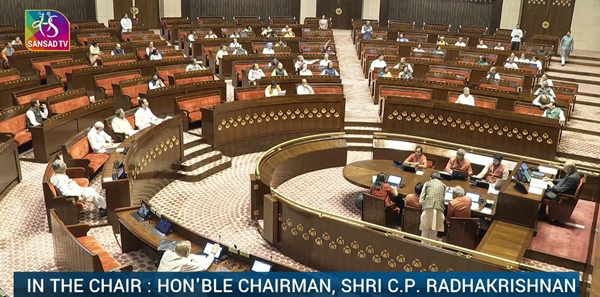
Rajya Sabha has taken up the Central Armed Police Forces (General Administration) Bill, 2026, for consideration and passing.
Minister of State for Home Affairs Nityanand Rai had introduced the Bill last week, which aims to regulate the general rules governing the recruitment and conditions of service of Group A General Duty Officers and other officers in the Central Armed Police Forces.
The Bill has provisions that 50 per cent of the total posts in the rank of Inspector General, and a minimum of 67 per cent of the posts in the rank of Additional Director General and all posts in the rank of Special Director General and Director General shall be filled by Indian Police Service (IPS) officers on deputation.
Initiating the discussion in the Upper House today, Saket Gokhale of TMC said that the Central Armed Police Forces (CAPF) is widely regarded as the first line of defence of the country.
He said, CAPF personnel are deployed in extremely challenging conditions, including deserts, high-altitude snow regions, and other hostile terrains.
Mr Gokhale said that these forces are often referred to as paramilitary forces because their roles and responsibilities closely resemble those of the armed forces rather than those of civilian police.
He expressed concern over the policies of the bill, which place IPS officers in top leadership positions within CAPF.
Brij Lal of the BJP said that the Bill proposes to establish a uniform and integrated framework for Group A General Duty officers in the Central Armed Police Forces (CAPF).
He said, its objective is to bring uniformity in recruitment and service conditions, enhance legal empowerment, and reduce litigation related to service matters.
Dr Ajeet Madhavrao Gopchade of the BJP said, this is not just a piece of legislation, but it is a decisive step to pull India’s security framework out of years of neglect.
He said, for decades, successive governments led by the Congress, left the Central Armed Police Forces (CAPF) operating under fragmented laws. He said, there was no unified framework, no clear policy and only confusion, delays, and endless litigation.
<