

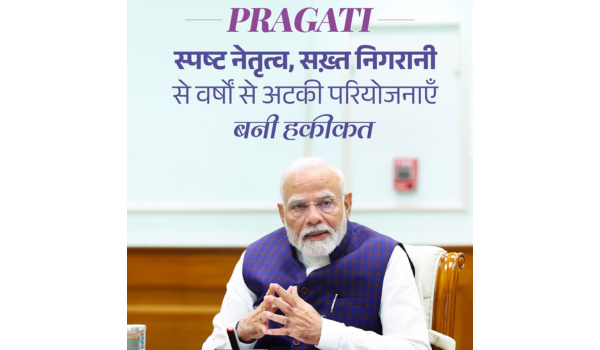
Prime Minister’s flagship platform for Pro-Active Governance and Timely Implementation, PRAGATI, has marked a significant milestone with the successful conduct of its 50th meeting. Since its launch by Prime Minister Narendra Modi in 2015, PRAGATI has transformed governance by enabling real-time monitoring and resolution of key infrastructure projects and public grievances through direct Prime Ministerial review.
The platform exemplifies cooperative federalism, bringing together the Centre, States, and Union Ministries on a single digital interface. Over a decade, PRAGATI has helped accelerate decision-making, resolution of issues causing delay in key infrastructure projects, and instilled a strong culture of accountability. It has also emerged as a platform for governance reforms, not merely monitoring.
The Doubling of the Bhubaneswar-Delang-Puri Rail Line of 70 kilometres was a critical railway infrastructure project undertaken by the Ministry of Railways and implemented by East Coast Railway in Odisha. The project, worth one thousand 650 crore rupees, was sanctioned in March 2012. This project was conceived in anticipation of the Nabakalebara festival scheduled in July 2015, which was expected to attract nearly 50 lakh devotees.
During construction, the project faced significant challenges concerning timely completion and commissioning. While substantial progress had been achieved, including doubling of the 40-kilometre Bhubaneswar-Delang section and the 13-kilometre Delang-Sakhigopal section, the remaining 17 km Sakhigopal-Puri stretch remained under execution. To avoid delay, Prime Minister Narendra Modi reviewed the projects under PRAGATI in June 2015.
During the review, Mr Modi directed the Ministry of Railways to ensure completion of all works well before the festival, and the State Government was advised to focus on security, drinking water and sanitation issues. This directive brought focused accountability to the implementing agency and elevated the project to a priority status. Following these interventions, the project achieved 100 per cent physical progress and was commissioned on 2nd July 2015.
With the corridor converted from a single line to a double line, train capacity on the route increased by nearly 2 to 3 times, allowing over 200 special passenger and MEMU trains to be operated during peak days. Beyond festival requirements, the corridor has contributed to long-term regional connectivity, tourism growth, and economic activity in Odisha.