


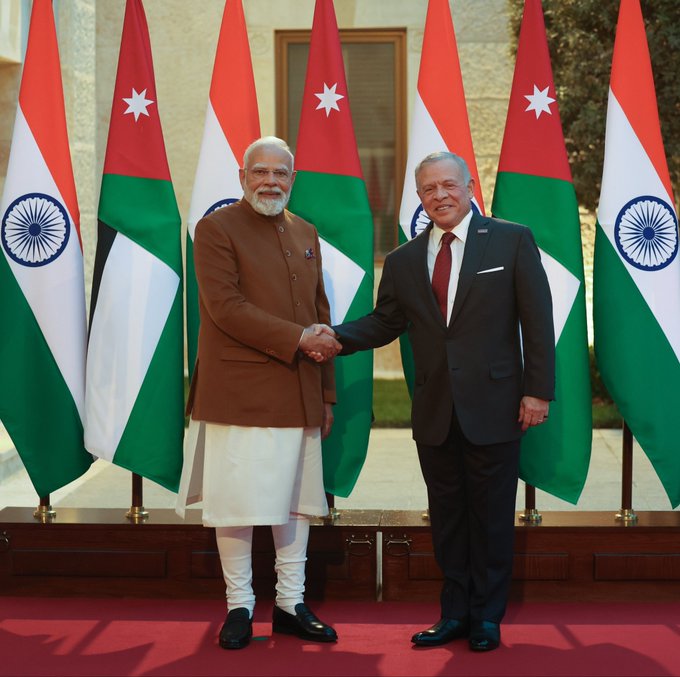
Prime Minister Narendra Modi’s visit to Jordan has delivered substantive outcomes across political, economic and cultural domains, senior officials said during a press briefing, describing the trip as significant as it coincides with 75 years of diplomatic relations between the two countries and marks the first full-fledged bilateral visit by an Indian prime minister to Jordan in 37 years.
Briefing the media, Secretary (south) Dr Neena Malhotra said the prime minister was accorded a ceremonial welcome, including a guard of honour, and held extensive engagements with Jordan’s leadership. “The two leaders held one-on-one talks followed by delegation-level discussions and exchanged views on bilateral, regional and global issues of mutual interest,” she said. Terrorism figured prominently in the talks, with Jordan expressing firm support for India’s position. “The king conveyed strong solidarity with India and reiterated that Jordan rejects terrorism in all its forms and manifestations,” she added, noting that Prime Minister Modi commended King Abdullah II’s leadership on de-radicalisation and his role as “a leading voice of moderation”.
Dr Malhotra said both sides reviewed economic cooperation, including Jordan’s role as a key supplier of phosphatic fertilisers to India. “The prime minister proposed enhancing bilateral trade to five billion dollars over the next five years,” she said, adding that companies from both countries are in discussions on further investments in Jordan to meet India’s growing fertiliser demand. Cooperation in new and renewable energy, information technology, water management and innovation was also discussed. Memorandams of understanding were finalised in areas including renewable energy, water conservation and rainwater harvesting, digital public infrastructure and cultural exchange.
A key outcome of the visit was the signing of a twinning agreement between Petra and Ellora to promote tourism and cultural cooperation. A letter of intent was also signed on digital transactions, including the use of RuPay cards, while discussions touched upon civil nuclear energy as a clean energy option, though officials said no specific agreement was concluded in this area.
Regional developments, including the situation in Gaza, were also discussed. Dr Malhotra said India welcomed efforts towards peace and reiterated its long-standing position on Palestine. Jordan’s initiatives such as the Aqaba Process were referenced, with officials noting that India has been participating in the multilateral counterterrorism platform.
Indian Ambassador to Jordan Manish Chauhan said there was strong interest in expanding cooperation in transport, railways and infrastructure, as well as people-to-people ties. “Education, research collaboration and student exchanges figured prominently in the discussions, and we look forward to taking these proposals forward,” he said.
Officials said the visit has strengthened trust and mutual understanding between the two countries and provided fresh momentum to the India-Jordan partnership, including cooperation in defence training, renewable energy initiatives such as solar and biofuels, and greater engagement with West Asia.