

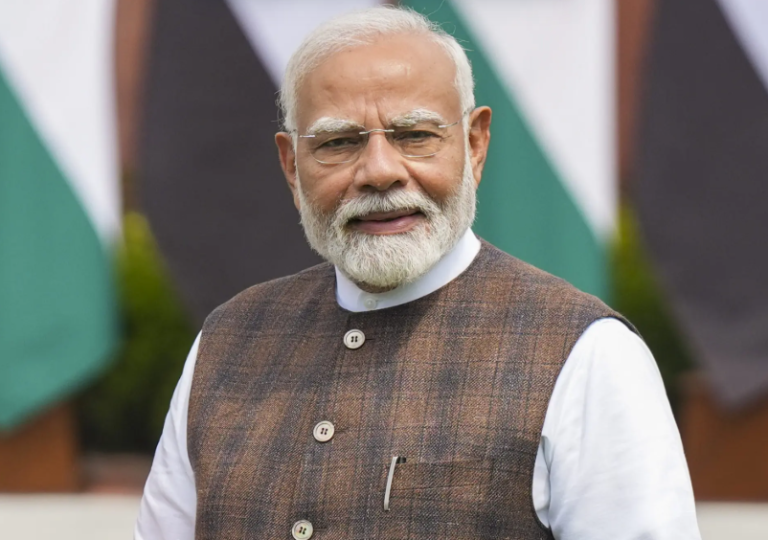
Prime Minister Narendra Modi has called upon the States to encourage manufacturing, boost ‘Ease of Doing Business’ and make India a Global Services Giant. Mr Modi said that soon India would be launching the National Manufacturing Mission (NMM) and every State must give this top priority and create infrastructure to attract global companies.
The Prime Minister said this while addressing the fifth National Conference of Chief Secretaries in New Delhi, which concluded yesterday. The three-day Conference began on the 26th of this month on the theme of Human Capital for Viksit Bharat.
Highlighting India’s demographic advantage, the Prime Minister stated that nearly 70 per cent of the population is in the working-age group, creating a unique historical opportunity which, when combined with economic progress, can significantly accelerate India’s journey towards Viksit Bharat.
The Prime Minister said that India has boarded the “Reform Express”, driven primarily by the strength of its young population, and empowering this demographic remains the government’s key priority.
Prime Minister remarked that the Conference is being held at a time when the country is witnessing next-generation reforms and moving steadily towards becoming a major global economic power.
Noting that Viksit Bharat is synonymous with quality and excellence, Mr Modi urged all stakeholders to move beyond average outcomes. Emphasising quality in governance, service delivery and manufacturing, the Prime Minister stated that the label “Made in India’ must become a symbol of excellence and global competitiveness.
In his address, the Prime Minister said that India must pursue self-reliance with zero defects in products and minimal environmental impact, making the label ‘Made in India’ synonymous with quality and strengthening the government’s commitment to ‘Zero Effect, Zero Defect.’ He urged the Centre and States to jointly identify 100 products for domestic manufacturing to reduce import dependence and strengthen economic resilience in line with the vision of Viksit Bharat.
The Prime Minister emphasised the need to map skill demand at the State and global levels to better design skill development strategies.
For the livelihoods of youth, he observed that tourism can play a huge role. He urged the States to prepare a roadmap for creating at least one global-level tourist destination and nourishing an entire tourist ecosystem.
Mr Modi said that it is important to align the Indian national sports calendar with the global sports calendar. He said, as India is working to host the 2036 Olympics, it needs to prepare infrastructure and sports ecosystem at par with global standards. He observed that young kids should be identified, nurtured and trained to compete at that time. He urged the States that the next 10 years must be invested in them, only then will India get the desired results in such sports events.
Prime Minister also emphasised that as India aspires to be the food basket of the world, there is a need to shift to high-value agriculture, dairy, and fisheries, with a focus on exports. He urged the States to use the Gyan Bharatam Mission for the digitisation of manuscripts. He said that States may start an Abhiyan to digitise such manuscripts available in States. Once these manuscripts are digitised, AI can be used for synthesizing the wisdom and knowledge available. The Prime Minister also said that all States and UTs must prepare a capacity-building plan along with the Capacity Building Commission.
In the conclusion, Prime Minister Narendra Modi said that every State must create 10-year actionable plans based on the discussions of this Conference with 1, 2, 5 and 10-year target timelines wherein technology can be utilised for regular monitoring.
The three-day Conference emphasised special themes which included Early Childhood Education; Schooling; Skilling; Higher Education; and Sports and Extracurricular Activities, recognising their role in building a resilient, inclusive and future-ready workforce.