April 17, 2026 10:20 PM

printer

Constitution amendment bill to implement women’s reservation fails in Lok Sabha

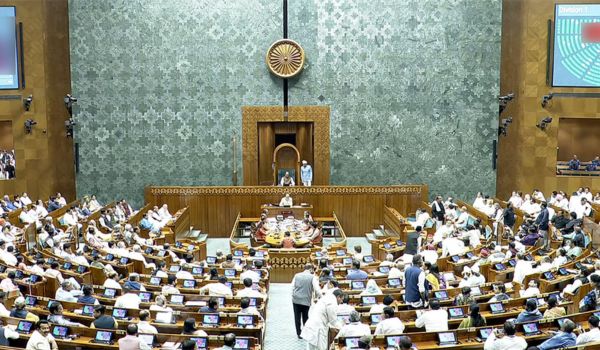
The Constitution (One Hundred and Thirty-First Amendment) Bill 2026, intended to implement one-third women’s reservation in the Lok Sabha and the legislative assembly, today failed to get the nod in the Lower House. The Bill fell short of the two-thirds majority of 352, out of the total 528 members present in the Lok Sabha.
 
During voting on the Bill, 298 MPs voted in favour of it and 230 against the bill. Lok Sabha Speaker Om Birla announced the results of the voting, saying that it is not possible to move forward with this legislation as it failed to get the required majority for its passage.
 
Afterwards, Parliamentary Affairs Minister Kiren Rijiju said the other two bills, including the Delimitation Bill, 2026, and the Union Territories Laws (Amendment) Bill, 2026, are interlinked with the Constitution (One Hundred and Thirty-First Amendment) Bill 2026, hence, these two bills will not be moved for passage. He accused the opposition of losing the opportunity to provide reservations to the women.
 
The Constitution (One Hundred and Thirty-First Amendment) Bill 2026 was intended to operationalise one-third reservation for women in the Lok Sabha and the legislative assemblies through delimitation exercise based on the latest published census. In 2023, the Constitution (One Hundred and Sixth Amendment) Act, known as the ‘NariShakti Vandan Adhiniyam’, was enacted. Under this legislation, one-third of the seats in the Lok Sabha and State Legislative Assemblies were reserved for women.
 
As the Bill was negated, the NDA MPs started protesting in the Parliament House, accusing the opposition of not supporting this important legislation for Nari Shakti. As the Constitution (One Hundred and Thirty-First Amendment) Bill 2026 Bill was negated in the House, the other two bills, including the Delimitation Bill, 2026, and the Union Territories Laws (Amendment) Bill, 2026 were not moved for passing. Later, the House was adjourned to meet again at 11 AM tomorrow. 
 
The Delimitation Bill 2026 provides for the constitution of the Delimitation Commission to undertake the exercise of delimitation, facilitating the reservation of seats for women in the Lok Sabha and the legislative assemblies. The Delimitation Commission is empowered with the task of carrying out delimitation of parliamentary and assembly constituencies and to allocate seats to be reserved for women, including women belonging to the Scheduled Castes and the Scheduled Tribes.
 
Union Territories Laws (Amendment) Bill 2026 seeks to amend the Government of Union Territories Act 1963, the Government of National Capital Territory of Delhi Act, 1991 and the Jammu and Kashmir Reorganisation Act, 2019. The legislation provides for the readjustment of parliamentary and assembly constituencies by the Delimitation Commission.
 
Earlier, Union Home Minister Amit Shah today said that the government will do everything to ensure reservation for women in the Lok Sabha and the legislative assemblies of States and Union Territories. He was replying to the discussion on the Constitution (One Hundred and Thirty-First Amendment) Bill, 2026, the Delimitation Bill, 2026, and the Union Territories Laws (Amendment) Bill, 2026 in the Lok Sabha. He said the objectives of these bills are to ensure that 2029 Lok Sabha polls are held with women’s reservation. 
 
Negating the opposition’s apprehensions on the delimitation exercise, the Minister said, provisions have been made in the constitution for the delimitation and this will lead to rationalisation of voters in every constituency. He said, number of seats for the Scheduled Castes and Scheduled Tribes increases with the delimitation exercise, and those who are opposing the delimitation exercise, they are actually opposing the increase in the number of seats for SC and STs.
 
He said, a narrative has been spread by the opposition that with the delimitation exercise, the number of Lok Sabha seats will reduce in the southern states. Referring to the states of Karnataka, Tamil Nadu, Andhra Pradesh, Telangana, and Kerala, Mr Shah said, out of the 543 seats in these five states, the current number is 129, which comes to a percentage of 23.76.
 
He said, after the increase, when the allocation for these five states is done after delimitation, the number of seats will rise from 129 to 195, and the percentage will be 23.87. He said, no one will suffer any loss. He also negated the allegations that the southern states will be treated unfairly. He said the country should not be divided along North-South lines. He claimed that even a small Union Territory like Lakshadweep has the same rights as Uttar Pradesh, Gujarat, and Bihar.
 
Taking a dig at the opposition alliance, the Home Minister said that no one has opposed the constitutional amendment for women’s reservation, but all members of the opposition have clearly opposed women’s reservation. He alleged that it was the Congress which restricted the delimitation exercise in the year 1972, and now it is also opposing it.
 
He said that whatever works done by the NDA government under the leadership of Prime Minister Narendra Modi, Congress has opposed it.  Mr Shah also clarified that the Indian Constitution does not recognise reservations based on religion. He said, despite this, the opposition, motivated by appeasement politics, seeks to demand reservations for Muslims, even as they cite the Constitution in support of their position.