






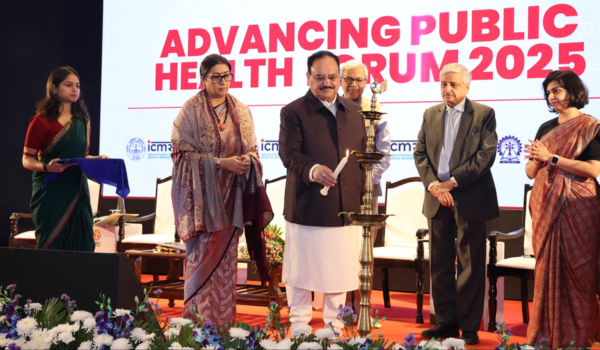
Health and Family Welfare Minister JP Nadda, today, said that malaria incidence in the country is declining by over 80 per cent and deaths by 78 per cent, showcasing India’s transition from a high-burden malaria country to a high-impact state.
Addressing the Advancing Public Health Outcomes Forum 2025 in New Delhi, Mr Nadda said that over 30 thousand Ayushman Arogya Mandirs (AAM) have received National Quality Assurance Standards (NQAS) Certification. He also noted that the government aims to establish one AAM for every two thousand population and said that this reflects the government’s commitment to strengthening primary healthcare.
On tuberculosis, the Minister highlighted that India has achieved a 21 per cent decline in TB incidence, significantly higher than the global decline of 12 per cent. He also underlined significant gains in maternal and child health outcomes. He mentioned that the Maternal Mortality Ratio has declined to 88 in this year, which was 130 per lakh live births in 2014. Meanwhile, the Infant Mortality Rate has reduced to 27 in the current year.
Mr Nadda further stated that Ayushman Bharat Pradhan Mantri Jan Arogya Yojana has significantly reduced out-of-pocket expenditure from 69 per cent to 39 per cent, strengthening financial protection for millions of families.
The Minister highlighted that sustained national efforts have led to tangible progress in controlling diseases, expanding immunisation coverage, and strengthening institutional and scientific capacities. He also noted that progress in disease control and immunisation reflects not isolated programmes, but institutional strength, Jan Bhagidari, and sustained political commitment. During the event, Mr Nadda also released four reports highlighting India’s achievements in Malaria, TB, Lymphatic Filariasis, and Immunisation.
