






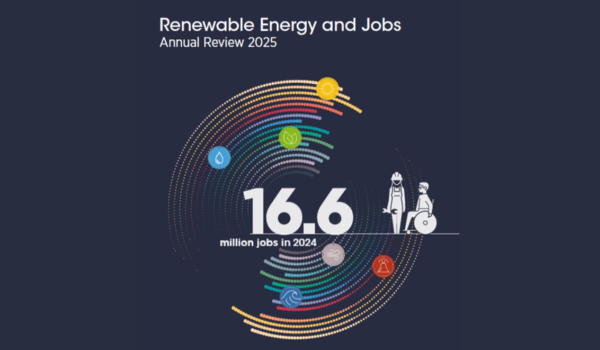
Renewable energy jobs recorded their first clear slowdown in growth even as global installations reached a new peak, according to a new report by the International Renewable Energy Agency and the International Labour Organisation. The Renewable Energy and Jobs – Annual Review 2025 said employment in the sector rose by only 2.3 per cent from 2023 to reach 16.6 million in 2024, reflecting growing geopolitical and geoeconomic frictions as well as increased automation across supply chains. The report said uneven development continues to define the global renewables workforce, with the European Union remaining at 1.8 million jobs, unchanged from 2023, while Brazil recorded about 1.4 million. Employment in India and the United States rose only marginally, reaching about 1.3 million and 1.1 million, respectively.
IRENA director-general Francesco La Camera said, “Renewable energy deployment is booming, but the human side of the story is as important as the technological side. Governments must put people at the centre of their energy and climate objectives through trade and industrial policies that drive investments, build domestic capacity, and develop a skilled workforce along the supply chain.” He added that the geographical imbalance in job growth highlights the need to restore international cooperation and support countries that are lagging behind in the transition.
Solar photovoltaics remained the largest employer in the sector, with 7.3 million jobs in 2024, driven by continued expansion in installations and manufacturing. Asia hosted 75 per cent of global solar PV employment. Liquid biofuels ranked second with 2.6 million jobs, followed by hydropower with 2.3 million and wind energy with 1.9 million.
The report also stressed the need for stronger inclusion and equity in the renewables workforce, warning that women and people with disabilities remain under-represented. ILO director-general Gilbert F. Houngbo said, “A just transition to a renewables-based future must be grounded in inclusion, dignity, and equal opportunity,” calling for accessible training systems, inclusive hiring practices and workplaces that respond to diverse needs. The annual review urged governments to strengthen public involvement in building domestic supply chains and to adopt inclusive policies to ensure that the socio-economic benefits of the energy transition are more widely shared.
